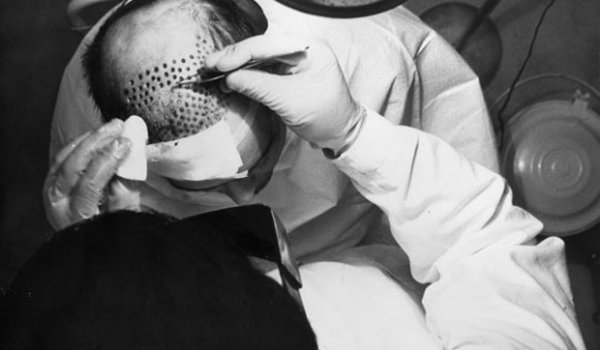
The concept of hair transplantation dates back to the 19th century, when it was first proposed by the German surgeon Johann Friedrich Dieffenbach. In practice, however, the Japanese doctor Okuda was the first to put the idea into effect.
Hair loss – when does the problem begin?
The average number of hairs on the scalp is approximately 110,000. Losing more than 100 hairs a day constitutes actual hair loss. Hair loss affects over 40% of men over the age of 35 and approximately 8–9% of women. Androgenetic alopecia (male-pattern baldness) accounts for more than 95% of hair loss in men. Hair loss is observed in over 70% of men over the age of 65. Men use minoxidil or finasteride as pharmacological treatments.
Some people combat hair loss using specialized light-therapy devices, cosmetic products, massagers, and the like. None of these methods, however, is as effective as a hair transplant.
The history of hair transplantation
The concept of hair transplantation dates back to the 19th century, when it was first proposed by the German surgeon Johann Friedrich Dieffenbach. The Japanese doctor Okuda put this method into practice and, in 1939, described the use of transplantation for the reconstruction of eyebrows and burned areas of the face.
 The concept of hair transplantation dates back to the 19th century, when it was first proposed by the German surgeon Johann Friedrich Dieffenbach. The Japanese doctor Okuda put this method into practice and, in 1939, described the use of transplantation for the reconstruction of eyebrows and burned areas of the face.
In 1959, American dermatologist Norman Orentreich became the first to perform a hair transplant to treat androgenetic alopecia in men. He formulated the theory that transplanted hair retains the characteristics of the donor site—a concept known as "donor dominance." It was not until the early 21st century that a Korean physician challenged this theory, pointing out that the recipient area does, in fact, influence the transplanted hair.
Originally, hair transplants resulted in a very unnatural appearance. In 1981, Finnish surgeon Rolf Nordström became the first to perform micro-transplants, a development that improved the aesthetic outcome of the procedure. During this same period, Brazilian surgeon Carlos O. Ubel became the first to transplant more than 1,000 hair follicles.
Nowadays, transplanting more than 2,000 hair follicles in a single session is the standard.
Hair transplant methods
 Nowadays, we use micro-instruments that allow hair transplant surgeries or procedures to be performed in a less invasive manner. A Google search reveals a wealth of information on FUT and FUE hair transplant methods, which predate the less invasive Micro FUE technique..
Method FUT (Follicular Unit Transplantation) It involves excising a strip of skin from the back of the head, after which the skin is sutured, leaving a large scar. The harvested scalp tissue is divided into hair follicles, which are then implanted into the recipient area. Typically, between 1,500 and 2,000 hair follicles are transplanted during such a procedure—an amount insufficient for advanced hair loss.
Method FUE (Follicular Unit Extraction) It emerged in the early 1990s. As the name suggests, it involves the individual extraction of each transplanted hair follicle from the occipital region. There is no need to excising a strip of skin—which would leave a scar in the donor area—and the procedure allows for the extraction of up to 5,000 hair follicles.