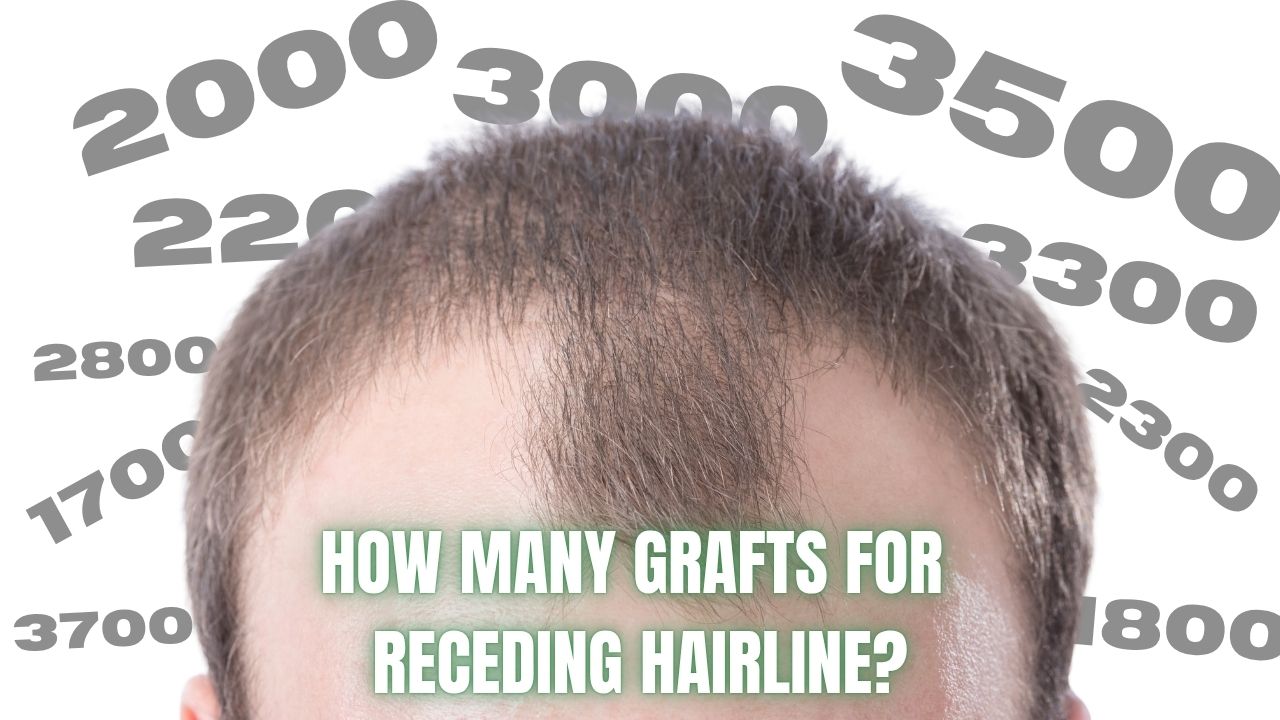
Which hair transplant for receding temples of hairline?
You are interested in a hair transplant to address receding temples and have decided to undergo the procedure in Turkey. After consulting online with several clinics—based on photos you submitted—you notice a significant discrepancy in the number of grafts proposed for the receding areas. What causes this difference? Which figure is closest to reality, and how many grafts do you actually need for the transplant to be performed correctly?
What is a receding temple of hairline?
Receding temples is the colloquial term for the part of the hairline affected by male-pattern baldness. The hairline recedes on both sides—right and left—towards the crown of the head, giving the frontal hairline an M-shaped appearance.
Receding temples are the first signs of male-pattern baldness, which can be either in an early or advanced stage.
Receding temples off hairline can be at an early or advanced stage of balding. The extent of hair loss is defined by the Norwood-Hamilton scale, which hair transplant surgeons use to determine whether a procedure will be small, medium, or large in scope.
What stage of hair loss do receding temples represent for a hair transplant?
During the initial consultation, the physician evaluating the patient for a hair transplant should conduct a detailed medical history review. The physician should assess the degree of hair loss, the progression of the condition, and the scope of the required transplant. All this information enables an accurate assessment of the procedure and a prediction of whether the area affected by hair loss is likely to expand in the near future.
Theoretically, a more advanced stage of balding requires more graft units for the receding hairline, but in practice, the hair transplant might turn out to be smaller.
Hair transplant surgeons use the Norwood scale—also known as the Norwood-Hamilton scale—to assess the extent of hair loss. The scale ranges from stage 1 to stage 7, with certain stages featuring variations depending on the specific pattern of hair loss. Receding hairlines typically correspond to stages 1 through 3 or 4 on the Norwood scale. A hair transplant for a receding hairline at stage 1 requires fewer grafts than one for a hairline at stage 3.
A hair transplant for receding temples involves varying numbers of grafts.
The Norwood-Hamilton balding scale, used by hair transplant surgeons, helps determine the scope and size of the hair transplant. The number of units required may vary between two cases presenting the same level of balding.
Two different patients qualifying for a hair transplant to address receding hairlines—both with Norwood 3-level balding—may require different numbers of grafts. There can be many reasons for this.
The first factor is head circumference, which translates to the surface area of the transplant site. If a patient with receding hairlines has a larger head circumference, he may require up to 50% more grafts than another patient with receding hairlines.
A second factor involves the facial muscles and the shape of the forehead; specifically, high-set facial muscles tend to result in a higher hairline. To maintain a natural look and proper facial proportions, the hairline should sometimes be positioned higher, in keeping with the patient's age. Conversely, another patient might have a narrow facial structure—without temporal hairline recession—and low-set facial muscles; in this case, a lower hairline would preserve the correct facial proportions and highlight the patient's youth.
A third reason for the variation in the number of grafts used to treat receding hairlines is the condition of the donor area and the prognosis regarding progressive hair loss. If the donor area is assessed as having low yield, fewer grafts are allocated to the receding hairline, a decision further reinforced by the patient's progressive hair loss.
How to calculate the number of grafts needed for receding temples?
The simplest and most effective approach is to attend an in-person consultation at a clinic or a dedicated facility. Aestepool Clinic operates its own consultation centers designed for the initial assessment of patients interested in a hair transplant to address receding hairlines.
Dr. Altan receives the prepared report and, based on the information it contains, precisely assesses the number of grafts required and the prospects for the hair transplant. The surface area is measured after determining the scope of the transplant and establishing a preliminary sample hairline. Multiplying the density rate by the calculated surface area (in cm²) yields the number of grafts for the recipient zone. The donor zone determines the graft density for the receding hairline areas, based on yield, natural hair growth density, and the average number of hairs per graft unit projected for those areas.
If a clinic offers 4,000 or 5,000 grafts for minor or moderate receding hairlines, it is a clear sign that they are trying to attract clients based on the number of grafts or lack an understanding of the basics of estimation.
The average receding hairline area for Norwood scale 3 is 30–40 cm², requiring restoration at a high density of 55–60 grafts per cm². The graft count is as follows.
30–40 cm² × 55–60 grafts/cm² = 1,650–2,400 grafts. The difference between the proposed 5,000 grafts and the actual calculated recipient area represents a loss of donor-area reserves needed to address potential progressive hair loss.
SUMMARY
The most important step is to conduct a thorough analysis before deciding to undergo a hair transplant. You have the right to know who will perform the procedure and exactly what their role will be. If the doctor’s involvement is limited, check whether the contract with the clinic clearly states this. It is also important to consider how long the clinic has been operating—specifically, when its website was registered. Search for the clinic’s name on Google to find independent reviews and check when they were posted. Additionally, look at the clinic’s social media profiles to see when they first published photos of their work and social media posts.